North London & online

DOIG Nutrition products

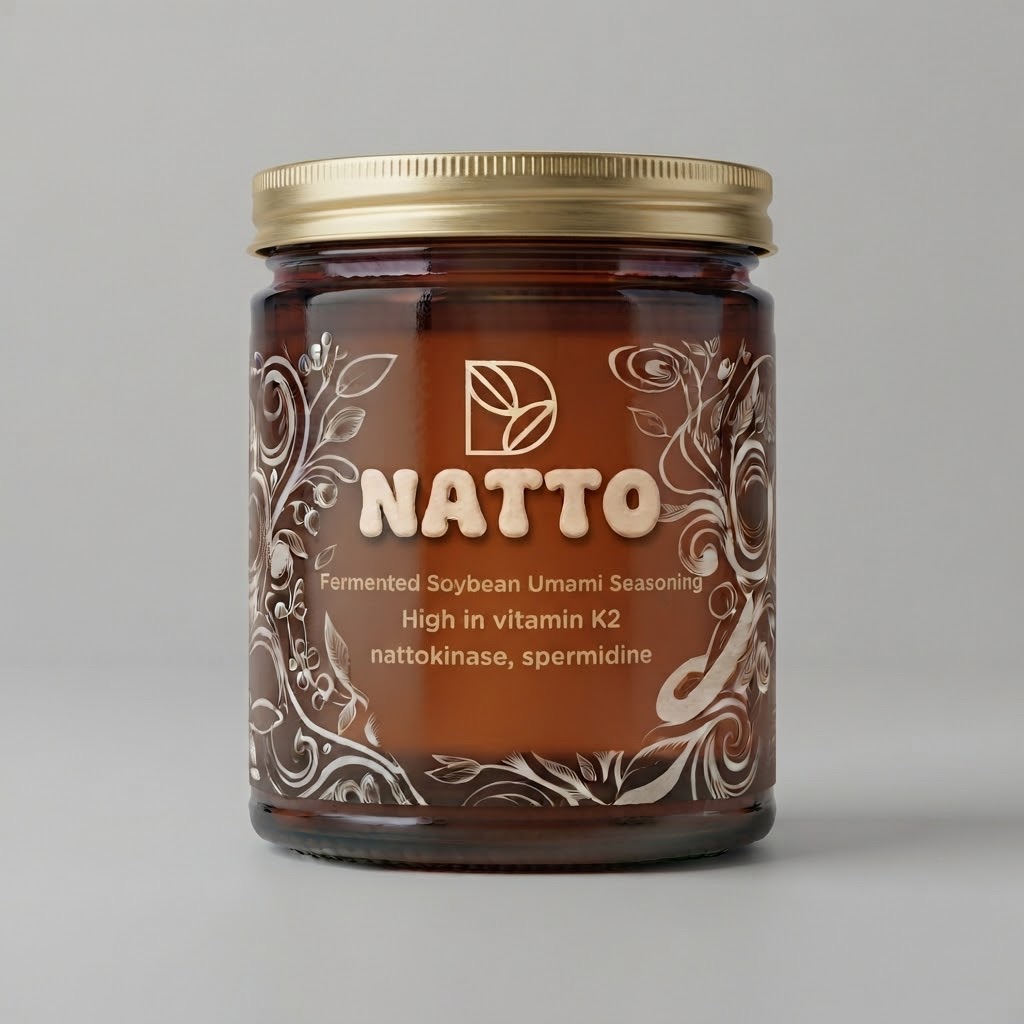
Natto 


A ceramic bowl of fermented soybean umami seasoning with a spoon

Pictured at the table, served alongside grain bowls

· Small batch

Fermented Umami Seasoning 

A savoury, nutty, deeply umami seasoning made from fermented soybeans. Sprinkle it over rice, eggs, greens, soups and roasted vegetables for instant depth.

£—— g jar
1
How to use it

Use it like a finishing salt: a teaspoon over a grain bowl, scrambled eggs, avocado toast, buttered greens, popcorn or a bowl of soup. Stir into dressings and marinades for depth.

Ingredients

Fermented soybeans

Nutrition information
Per 100 gPer 5 g serving
Energy—
Fat—
of which saturates—
Carbohydrate—
of which sugars—
Fibre—
Protein—
Salt—

Values to be confirmed by laboratory analysis before launch.

Allergens

Contains soya. Confirm any other allergens and whether it’s made in a kitchen that handles other allergens.

Storage

Store in a cool, dry place with the lid tightly closed. Use within — weeks of opening.

FAQs

Is it natto? It’s made from fermented soybeans in the spirit of natto, but dried into a seasoning. It doesn’t have natto’s sticky texture.

Is it a supplement? No. It’s a food and a seasoning, made to add flavour to everyday cooking.

I take warfarin — can I eat it? Fermented soybean products can be high in vitamin K. Please check with your GP or pharmacist first.

My background

Why I made it

I come from a professional chef background, specialising in fermentation, and I have always been interested in how food can support health and wellbeing. I’m currently studying for a BSc in Nutritional Therapy, which has let me build my understanding of nutrition alongside my practical experience in the kitchen.

I want to create products that are genuinely nutritious but, just as importantly, taste good and are easy to use. Rather than products that feel like supplements, I want DOIG Nutrition’s range to sit between nutrition, food and everyday cooking.

My first product is a fermented natto seasoning. I’m interested in taking traditional, nutrient-dense foods and making them more approachable and enjoyable for a modern Western kitchen.

Recipe ideas


→


→


→

What is natto?

Japan’s fermented soybean

Natto is a traditional Japanese food made from fermented soybeans. It has been a nutrient-rich staple in Japan for centuries, but it remains relatively unfamiliar in the West, and its distinctive aroma and famously sticky texture can be an acquired taste, especially if you didn’t grow up eating it.

What’s different about DOIG natto?


By dehydrating and milling the fermented soybeans, the texture and flavour profile transforms  into  a tasty umami rich seasoning that  can be sprinkled over eggs, stirred into broths or add to you everyday favourites, for an extra layer of savoury flavour and a  crazy high nutritional boost.

Why natto?

The richest known food source of vitamin K2

Natto is widely recognised as the richest natural source of vitamin K2, in its MK-7 form, which stays in the bloodstream much longer than vitamin K1. Other foods contain far less: hard cheeses, egg yolks and some fermented vegetables provide roughly 10–150 µg per 100 g.

Vitamin K2

What does it do?

Vitamin K2 is a fat-soluble vitamin. Vitamin K contributes to normal blood clotting and to the maintenance of normal bones.

  • Bones: K2 activates osteocalcin, a protein that helps bind calcium into bone. In Japan, a form of vitamin K2 (MK-4) is prescribed for osteoporosis.
  • Arteries: K2 activates matrix Gla protein, which helps stop calcium building up in blood vessel walls. Higher K2 intake has been associated with lower heart-disease risk.
  • Works with vitamin D: vitamin D increases calcium absorption, and K2 helps direct that calcium to bone rather than soft tissue.

Nattokinase

An enzyme unique to natto

Beyond vitamin K2, natto is the natural source of nattokinase, an enzyme discovered in natto. Research suggests it may:

  • Support healthy circulation and blood flow
  • Work alongside vitamin K2 in cardiovascular health

Most research uses concentrated nattokinase supplements; how much survives in a dried seasoning hasn’t been measured.

Spermidine

A compound linked to cellular health

Natto is one of the richest food sources of spermidine, a compound being researched for its links with cellular health and healthy ageing.

The research

What the studies say

Ten studies on natto, vitamin K2 and nattokinase, explained in plain English, including the ones that didn’t find a benefit.

Cohort studyFollows people over years. Shows a link, not proof.Clinical trialTests a treatment against a placebo.Meta-analysisPools the results of several studies.
~40%lower risk of death from any cause in older men eating natto several times a weekFujita 2025
25%lower risk of cardiovascular death in the highest natto eatersTakayama study 2017
−3.5 mmHgaverage fall in systolic blood pressure with nattokinase supplementsLi 2023
01

Natto & longevity

Large, long-running studies of Japanese adults who eat natto as part of everyday life.

Cohort study1,548 older men · ~12 years average follow-up

A 15-year cohort study of self-reported fermented soybean (natto) intake and all-cause mortality in elderly men

Key findingMen eating natto several times a week had about 40% lower risk of death from any cause than men who ate none.

The link was strongest in men who kept eating natto over the long term. Men eating a pack a day or more also had lower risk, but that difference wasn’t statistically clear.

Fujita Y, et al. Clinical Nutrition ESPEN. 2025;68:699–706

Cohort study92,915 adults · 14.8 years follow-up

Association of soy and fermented soy product intake with total and cause-specific mortality

Key findingPeople eating the most fermented soy (natto and miso) had about 10% lower risk of death from any cause.

Natto in particular was linked with lower risk of death from cardiovascular disease in both men and women. Total soy intake on its own showed no link, which points to fermentation.

Katagiri R, et al. BMJ. 2020;368:m34

Cohort studyJapanese adults · 16 years follow-up

Dietary soy and natto intake and cardiovascular disease mortality in Japanese adults: the Takayama study

Key findingThe highest natto eaters had 25% lower risk of death from cardiovascular disease than the lowest.

Higher natto intake was also linked with lower risk of death from stroke. Other soy foods didn’t show the same link.

Nagata C, et al. American Journal of Clinical Nutrition. 2017;105(2):426–431

02

Vitamin K2: bones & arteries

Natto is the richest food source of vitamin K2 (MK-7). These studies look at what that means for bones and the heart.

Meta-analysis6 studies · 2,327 people

Habitual natto intake elevates serum MK-7 levels, enhances osteocalcin carboxylation, and supports bone density

Key findingRegular natto eaters had higher vitamin K2 levels, better-activated osteocalcin (a bone protein) and modestly higher bone density.

The authors rate the bone-density evidence as low certainty, as the studies were observational and all in Japan.

Wen Z, et al. Frontiers in Nutrition. 2025;12:1713726

Cohort studyDutch adults aged 55+ · ~7 years follow-up

Dietary intake of menaquinone is associated with a reduced risk of coronary heart disease: the Rotterdam Study

Key findingPeople with the highest vitamin K2 intake had markedly lower risk of dying from coronary heart disease.

Vitamin K1 (from leafy greens) didn’t show the same link, which is why K2 gets particular attention for arteries.

Geleijnse JM, et al. Journal of Nutrition. 2004;134(11):3100–3105

ReviewNarrative review

Growing evidence of a proven mechanism shows vitamin K2 can impact health conditions beyond bone and cardiovascular disease

Key findingExplains how vitamin K2 activates proteins that guide calcium into bone and away from artery walls.

A useful overview of the mechanism, rather than new evidence of benefit.

Maresz K. Integrative Medicine. 2021;20(4):34–38

03

Nattokinase & heart health

Nattokinase is an enzyme found in natto. These trials use concentrated supplements, not natto as a food, and the results are mixed.

Meta-analysis6 trials · 546 participants

Nattokinase supplementation and cardiovascular risk factors: a systematic review and meta-analysis of randomized controlled trials

Key findingNattokinase lowered blood pressure by about 3.5 mmHg (systolic) and 2.3 mmHg (diastolic) compared with placebo.

It didn’t improve cholesterol, and the authors call for more research on dose.

Li X, et al. Reviews in Cardiovascular Medicine. 2023;24(8):234

Clinical trial79 adults with raised blood pressure · 8 weeks

Consumption of nattokinase is associated with reduced blood pressure and von Willebrand factor

Key findingDiastolic blood pressure fell from 87 to 84 mmHg on nattokinase, while it stayed the same on placebo.

A randomised, double-blind, placebo-controlled trial. The effect was strongest in men.

Jensen GS, et al. Integrated Blood Pressure Control. 2016;9:95–104

Clinical trialHealthy adults at low heart risk · ~3 years

Nattokinase atherothrombotic prevention study: a randomized controlled trial

Key findingNo difference from placebo in artery thickening, plaque, blood pressure or blood tests.

An important, well-run trial showing nattokinase supplements may not help people who are already at low risk.

Hodis HN, et al. Clinical Hemorheology and Microcirculation. 2021;78(4):339–353

Clinical study1,062 participants · 12 months

Effective management of atherosclerosis progress and hyperlipidemia with nattokinase: a clinical study with 1,062 participants

Key findingNattokinase supplementation was linked with better cholesterol levels and smaller artery plaques after a year.

There was no placebo group, so it can’t show cause and effect the way a controlled trial can.

Chen H, et al. Frontiers in Cardiovascular Medicine. 2022;9:964977

Most of these studies were done in Japan, where natto is eaten as a whole food. The nattokinase trials use concentrated supplements, and how much nattokinase survives in a dried seasoning hasn’t been measured. These studies describe natto in general, not DOIG products specifically.

Safety: natto is very high in vitamin K, and nattokinase may affect blood clotting. If you take warfarin or other blood-thinning or antiplatelet medication, speak to your GP or pharmacist before eating natto products. Contains soya. This is a food, not a medicine or supplement.

Reviews

What people say

Verified customer reviews will appear here after launch.

Coming next

Natto Multi-Seed & Nut Topping

A versatile blend of roasted nuts, seeds and powdered natto, adding texture, savoury flavour and protein, healthy fats and fibre. Sprinkle over salads, Buddha bowls, soups and overnight oats.

Photograph to comeOriginal

Original

Powdered natto, pumpkin seeds, sunflower seeds, flaxseed, sesame seeds, almonds, peanuts and seaweed

In development

Photograph to comeCurried

Curried

Powdered natto, cashews, pumpkin seeds, flaxseed, sesame seeds, curry spices and toasted coconut

In development

Photograph to comeSpiced

Spiced

Powdered natto, almonds, sunflower seeds, pumpkin seeds, flaxseed, chilli, smoked paprika and cumin

In development

Photograph to comeHoney

Honey & Seed

Powdered natto, almonds, pumpkin seeds, sesame seeds, honey and warming spices

In development

Also in development

Mushroom & natto seasoning blends

Natto powder combined with popular mushrooms, each with its own nutritional profile and naturally occurring compounds. A simple, food-first way to bring fermentation and mushrooms into everyday meals.

ReishiLion’s maneMaitakeShiitakeChagaCordyceps

Allergens: the toppings contain nuts, peanuts, sesame and soya.